Castle Rock bombing attacks
Needful ThingsThe Castle Rock bombing attacks bring the town’s escalating violence to its catastrophic climax. Orchestrated by Ace Merrill and Buster Keeton under Leland Gaunt’s influence, the bombings culminate in the destruction of the Municipal Building, where nineteen people die. The sequence makes the town’s breakdown literal: grievances and private bargains have become a public assault on the places and people meant to hold Castle Rock together.
Causes and Background
The destruction is the culmination of Gaunt’s campaign to turn resentment into action. Ace and Buster carry out the bombing plan, planting forty sticks of dynamite in two groups of twenty at the Municipal Building. Their targets reflect both civic authority and the town’s governing structure: one bomb is placed on the judge’s chair in the courtroom, and Buster insists that the other go on Amanda Williams’s desk in the Selectmen’s Wing. He justifies that choice to Ace by declaring that women have no business in politics.
The scale of the Municipal Building attack distinguishes it from the other explosions. It is the final blast and dwarfs the preceding destruction. Yet its consequences are not confined to the building: newspeople covering the growing disorder are among those killed, and police and news vehicles are caught in the blast. What began as a plan to turn the town against itself ends by destroying the town’s civic center and killing people drawn there by the crisis.
The Bombings Across Town
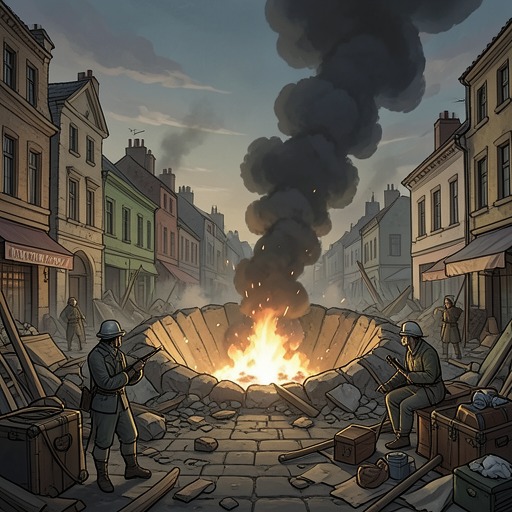
The explosions unfold amid the violence already spreading through Castle Rock. As Polly Chalmers nears the green awning of Needful Things, the funeral parlor and barber shop explode. The force sends debris through her Toyota; the car, left without a driver to control it, mounts the curb, hits a fire hydrant, and stalls. From the damaged car, Polly sees Alan Pangborn emerge from Needful Things and head toward one of the cars outside.
Elsewhere, another blast floods Main Street with light and sends a Double Dragon arcade machine from the ruins into the street, where it lands upside down. During the explosion of the video-game parlor, Alan is in his car in the middle of Main Street. He picks up the fake Tastee-Munch Mixed Nuts can and holds it on his lap as if seeking comfort. Polly, focused on him, reveals that she has removed the charm. The town’s physical destruction and the crisis in their relationship converge in this moment, while the blasts continue around them.
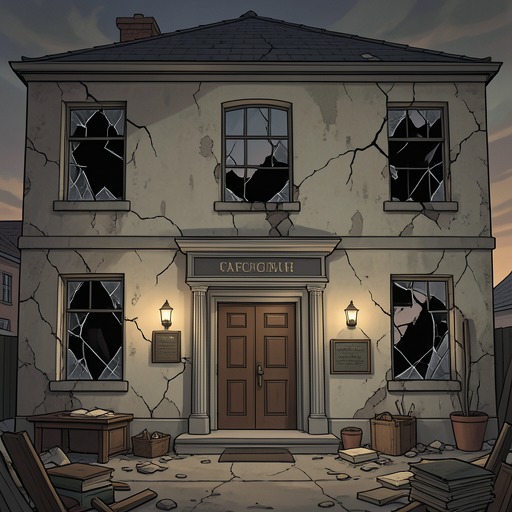
The final explosion destroys the Municipal Building. Fire breaks through its openings, the slate roof rises and then shatters, and the structure bursts outward, filling Lower Main Street with brick and glass. Nineteen people are killed, including five newspeople who had come to report on Castle Rock’s escalating strangeness. The blast throws State Police cars and news vehicles through the air. The yellow van supplied to Ace and Buster travels above Main Street before crashing into the Dostie Insurance Agency, spilling tools and timers from its damaged rear.
The Final Blast and Its Victims
The Municipal Building explosion also interrupts a possible reconciliation. Frank Jewett and George T. Nelson, whose quarrel has brought them to the building, begin to approach one another with tentative, matching grins. Their hostility appears on the verge of giving way when the blast kills them both. The brief reversal gives the explosion a consequence beyond the destruction of property: it extinguishes a chance for the two men to settle their conflict.
The attack’s placement underscores its assault on public life. The judge’s chair and Amanda Williams’s desk are not incidental locations: the explosives are deliberately put in the courtroom and the Selectmen’s Wing. Buster’s stated contempt for women in politics makes the second placement an expression of his prejudice as well as a tactical choice. The resulting blast leaves no room for political argument or repair; it annihilates the building and the people inside or nearby.
Aftermath and Significance
The destruction reaches far beyond the Municipal Building. The explosion shakes the ground and breaks windows across town. Weathervanes that had been pointing steadily northeast begin to spin, and some are torn from their spindles. The ordinary landmarks and mechanisms of the town are caught up in the same disorder as its people.
The bombing campaign turns the novel’s pattern of manipulated grievances into an irreversible public disaster. Its victims include people whose quarrels had only just begun to thaw, as well as reporters who arrived to observe the town’s crisis. The explosions do not resolve the conflicts that Gaunt has exploited; they erase lives and damage the civic spaces where those conflicts might have been addressed. At the Municipal Building, resentment reaches its most destructive form, and the town’s struggle over authority ends in the destruction of the place that represents it.